How to Wash a Matching Set So the Colors Still Match Next Year
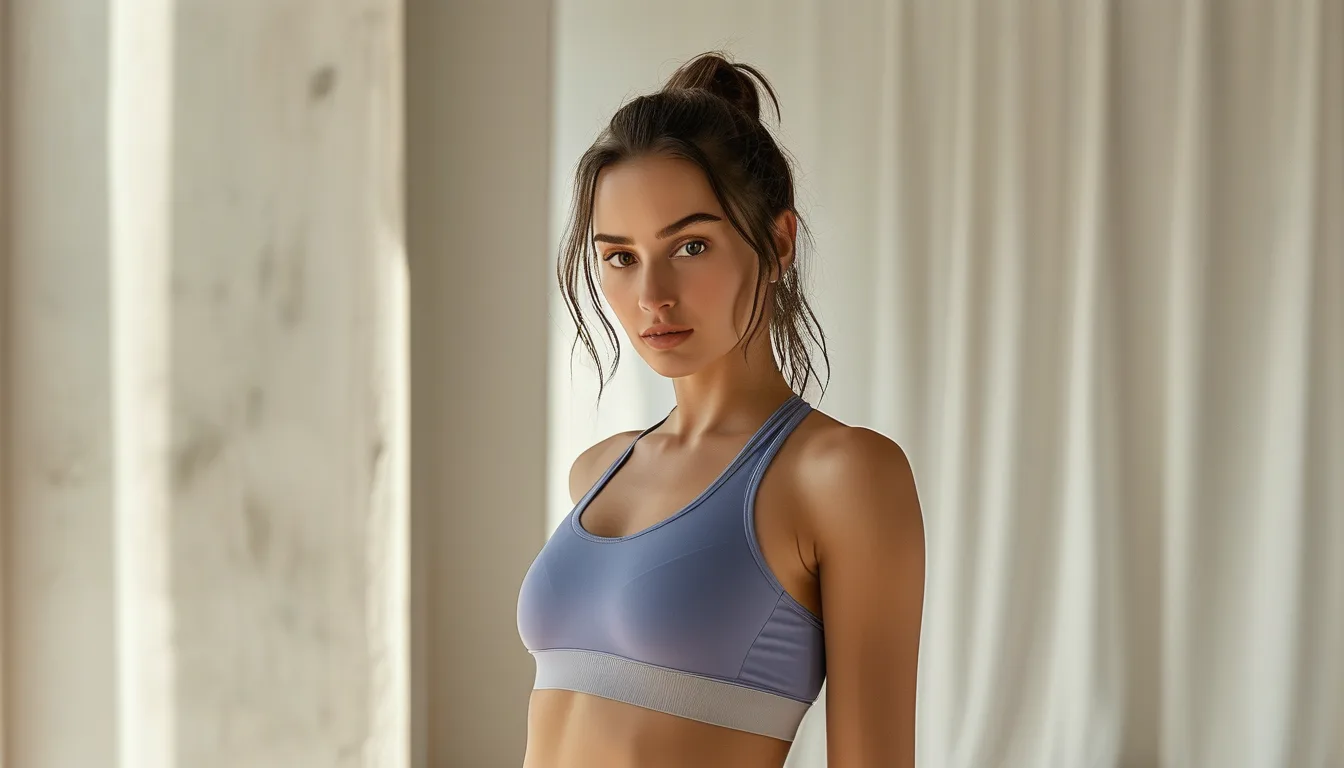
Quick Answer: Matching sets drift apart in color because the two pieces are worn, sweated on, and washed at different rates, and often cut from different fabric blends that release dye differently. The fix is treating the set as one unit: wash both pieces together every time even if only one was worn, cold water inside out in a mesh bag, no dryer, and dried away from sunlight. Uneven care, not cheap dye, is what un-matches most sets.
A matching set is really a color-matching contract between two garments, and every wash is a chance for one of them to break it. The leggings get worn twice as often, sweated on twice as hard, and washed twice as much — of course they fade first. The good news is that the drift is almost entirely a habit problem.
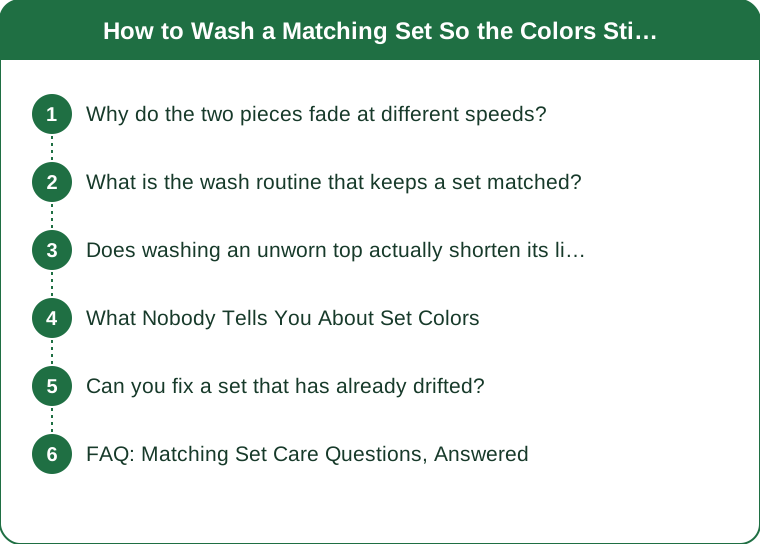
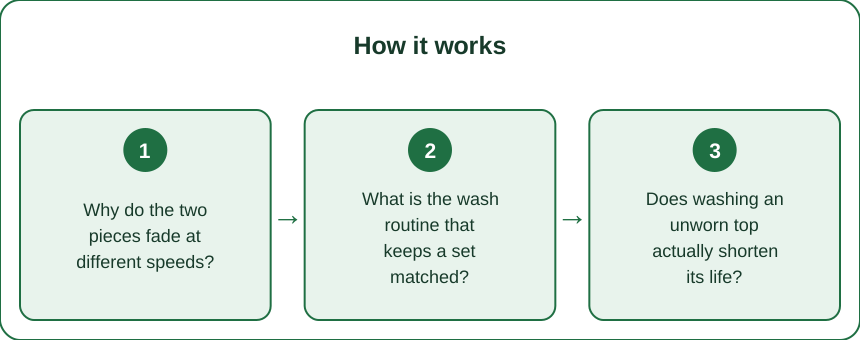
Why do the two pieces fade at different speeds?
Three gaps open up between a top and its matching bottom.
Wear frequency. Most people reach for the leggings with other tops constantly, while the matching top waits for the full-set days. Twice the wears means twice the washes, twice the sweat exposure, and twice the friction. A year in, the leggings have lived a different life.
Fabric composition. Brands routinely cut the top and bottom from different knits — a compression blend below, a lighter modal-heavy or ribbed fabric above. Same dye lot, different fibers, and different fibers hold dye differently. Polyester keeps color stubbornly; anything with rayon, modal, or cotton in the blend releases it faster.
Sweat chemistry. Sweat is mildly acidic and salty, and it sits longest where the body pushes hardest — waistband, underband, back panel. Left in a hamper for days, it works on dye and elastane both. The piece that absorbs more sweat ages faster even at identical wash counts.
You cannot change the fabric decisions, but the wear and wash gaps are entirely yours to close.
What is the wash routine that keeps a set matched?
Six rules, none of them exotic.
Wash the pair together, always. This is the one that matters most. If the leggings got worn, the top rides along, even clean. Identical wash counts are the whole game — a top washed 15 times and leggings washed 40 cannot be the same color.
Cold water only. Heat opens fibers and releases dye. Cold keeps the dye seated and protects the elastane that gives buttery-soft leggings their recovery.
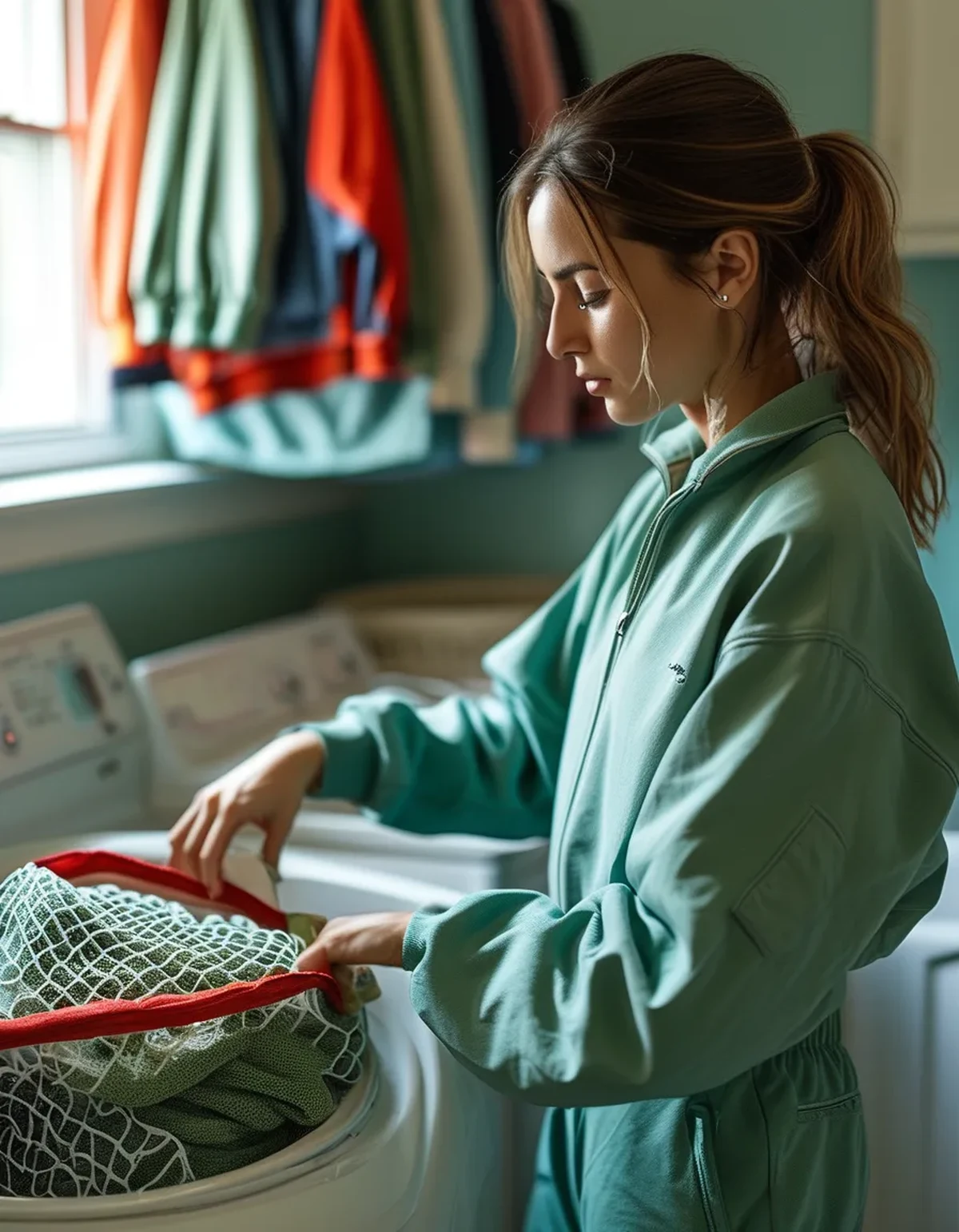
Inside out, in a mesh bag. Fading is partly physical — surface fibers abraded by zippers and drum tumbling scatter light and read as faded even when dye remains. Turning pieces inside out puts the sacrificial wear on the hidden face.
Gentle detergent, no softener. Softener coats technical fabrics, kills wicking, and dulls color with residue.
Skip the dryer entirely. Dryer heat is the single fastest ager of both dye and stretch. Hang both pieces.
Dry in shade. A dark set drying on a sunny balcony rail can visibly lighten in a season of afternoons. UV does not care that the wash was cold.
Does washing an unworn top actually shorten its life?
Slightly, and it is still the right trade.
Every wash costs a garment something — a little dye, a little fiber, a little elastane fatigue. Washing the unworn top alongside its worn partner spends that cost deliberately to keep the two pieces on the same aging curve. The alternative is a top that outlives its leggings by a year while matching nothing.
If the extra washes bother you, close the gap from the other side: wear the top more. Style it with other bottoms — a matching-set top over black yoga pants or under an open shirt works as hard as any standalone piece. Evening out the wear evens out the washing naturally, and you get more outfits out of the set in the bargain.
The compromise position for lightly-worn days: rinse both pieces briefly by hand in cold water with a drop of detergent. A two-minute rinse removes sweat salts — the most corrosive part of wear — at a fraction of a full wash cycle’s wear-and-tear. It keeps the pair synchronized without running the machine.
What does not work is alternating: full wash for the leggings, nothing for the top, repeated forty times. That is precisely the schedule that produces two shades of one color.

What Nobody Tells You About Set Colors
Dye lots vary more than brands admit. The sage top and sage leggings you bought in March were dyed in the same batch and matched perfectly. Buy a replacement top in August and it may arrive a barely-different sage, because it came from a different lot. If a set matters to you, replace pieces quickly or not at all — and if you are buying a set you know you will live in, buying it twice while the lot is current is not as absurd as it sounds.
Heathered and marled sets hide drift dramatically better than saturated solids. The visual noise of a melange knit camouflages a half-shade difference that would be obvious in flat black or bright rust. If you know your care habits are chaotic, heather is the honest choice.
Dark saturated colors show fade first, but white sets un-match too — through yellowing, and unevenly, because sunscreen and body oils hit the two pieces differently. White sets need the same paired-wash discipline, plus an occasional oxygen-bleach soak for both pieces together, never one.
And the fastest un-matcher of all is not the washer. It is one piece left in a hot car, one piece draped over a radiator, one piece on the sunny end of the drying rack. Storage and drying asymmetry beats wash asymmetry every time.
Can you fix a set that has already drifted?
Sometimes, within limits.
Assess in daylight first. Indoor bulbs exaggerate some shifts and hide others. If the pair reads matched outdoors and off by a shade under the bathroom LED, you may only have a lighting problem, and no one at the gym will ever see it.
A fabric-specific color reviver helps mild, even fade on darks — these products deposit a small amount of dye and work best on black and navy. Treat both pieces together, following the packet exactly, and expect improvement rather than restoration.
Re-dyeing is the nuclear option and only works if you respect fiber content: synthetic-heavy activewear needs disperse dyes made for polyester, not the all-purpose box from the craft aisle, and elastane tolerates the required heat poorly. It can rescue a beloved set headed for the donation bag anyway; it is a gamble on anything you would pay to replace.
Reframing is the free fix. A drifted set is two coordinating pieces now — wear the deeper leggings with the lighter top like an intentional tonal outfit, and it reads as styling rather than laundry failure. Tonal dressing is doing you a favor this year.
And going forward, the paired-wash rule starts today, not after the next set.
FAQ: Matching Set Care Questions, Answered
How often should I wash a set I only wore for an hour?
Low-sweat wear earns a cold hand rinse or simply airing out flat — but whatever the worn piece gets, the partner gets. The rule is identical treatment, not maximum treatment.
Do color-catcher sheets keep sets matched?
They protect the set from other garments’ dye, which prevents tinting rather than fading. Useful insurance in mixed loads, but they do nothing about the wear-rate gap that actually un-matches sets.
Is hand washing better than machine washing for sets?
Gentler, yes — less friction means slower physical fade. But consistency beats method: both pieces hand washed together beats leggings machine washed and top hand washed. Pick the routine you will actually repeat and apply it to the pair.
My set is polyester and spandex — does the no-dryer rule still apply?
Especially then. Polyester holds dye well, but spandex is heat’s first victim, and a set that still matches in color while one piece has gone baggy at the knees is un-matched in a different way. Air drying protects the fit half of the contract.
TL;DR:
- Sets un-match because the pieces get different wear, washes, and sweat — close the gap by washing the pair together every time.
- Cold water, inside out, mesh bag, no softener, no dryer, shade drying: the full routine takes no extra minutes.
- Wear the top with other bottoms to even out wear naturally; a quick cold rinse keeps light-wear days synchronized.
- Drifted sets can be revived (color restorer, careful re-dye) or restyled as an intentional tonal outfit.
A matching set stays a matching set for exactly as long as you treat it like one garment that happens to come in two parts. Start the paired-wash habit with the next load and next summer’s version of this set will still agree with itself.
See It in Motion
Seen here: High Waist 8” Yoga Shorts — shop similar styles on bubblelime.com
Keep Reading
This article is for general informational and styling purposes only. Fit, sizing, and product availability may vary.