How to Wear Half a Matching Set Without It Looking Orphaned

Quick Answer: Half a matching set looks orphaned when the piece keeps signalling that it belongs to something else, usually through a matching trim, a distinctive fabric sheen, or a hem finish that only makes sense with its partner. The fix is to give the orphan a new partner with a deliberate relationship: match the fabric weight, contrast the colour clearly rather than nearly, and add a third piece that repeats one element of the orphan. Near-matches are what read as a mistake, and clear contrast almost never does.
You bought the set because it looked good together. Then you tried the top with jeans and something was off in a way you could not name.
The piece is fine. The problem is that it is still wearing its half of a conversation, and nothing else in the outfit is answering.

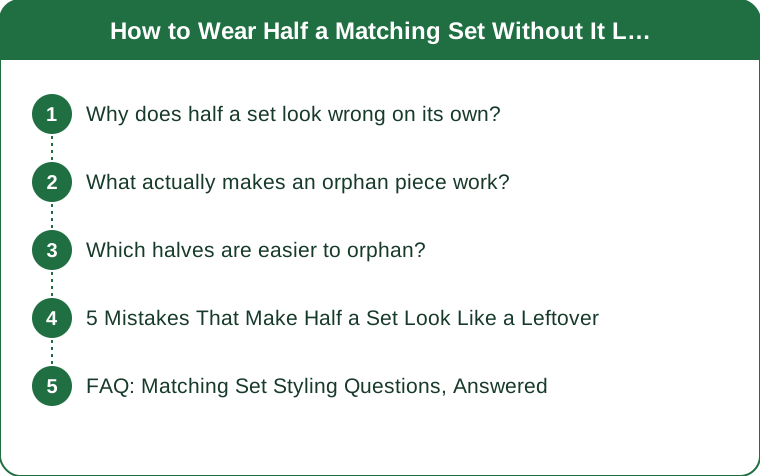
Why does half a set look wrong on its own?
Because set pieces are designed with matched signals, and those signals become loud when the partner is missing.
The three signals that give it away:
- Fabric sheen. Sets are usually cut from a single roll, so the top and bottom reflect light identically. Alone, that sheen has nothing to rhyme with and reads as slightly synthetic against ordinary separates.
- Trim and binding. A contrast bind at the neckline that repeated at the waistband made sense as a system. On its own it looks like a detail with no purpose.
- Proportion. Set tops are frequently cut to a specific length designed to meet a specific rise. Worn with a different bottom, the hem lands in a place nobody drafted for.
The near-match trap. The most common failure is pairing the orphan with something almost the same colour. Two blacks that differ slightly, or a beige against a cream, look like a failed attempt at matching rather than a choice. Your eye reads near-matches as errors and clear contrasts as intent.
A quick diagnostic: photograph the outfit and look at it small, on your phone, from arm’s length. Near-matches are much more obvious at small size than in a mirror, because the mirror gives you texture information the photo removes.
What actually makes an orphan piece work?
Three moves, in the order that makes the most difference.
1. Match the fabric weight, not the colour. This is the single highest-value adjustment. A lightweight ribbed set top works with something equally light, like a fluid trouser or a soft midi skirt, and fights with heavy denim. Weight mismatch is what people usually feel as the outfit not working, and they misdiagnose it as colour.
2. Contrast decisively. If the orphan is a colour, put it against a true neutral. If it is a neutral, put it against a strong colour or a clearly different neutral, meaning cream against charcoal rather than cream against oat. The rule of thumb: if you have to think about whether they match, they do not.
3. Add a third piece that repeats one element. A jacket, a belt, a scarf, or a shoe that picks up the orphan’s colour or texture gives the piece an ally. Once something else in the outfit relates to it, it stops reading as a leftover and starts reading as a deliberate choice.
A fourth move for tops specifically: change the hem relationship. A set top designed to sit at a high waistband can be tucked, half-tucked, or knotted with a different bottom. The length that looked wrong loose often looks intentional tucked.

Which halves are easier to orphan?
They are not equally reusable, and knowing which is which changes what you buy.
Bottoms are usually the easier orphan. Leggings, trousers, and skirts from sets are typically cut in solid colours with few distinguishing details, and they read as ordinary separates immediately. If a set has one piece you expect to wear constantly on its own, plan for it to be the bottom.
Tops are harder, and it depends on the neckline. A plain scoop or crew is easy. A high-neck with a contrast bind, a distinctive zip pull, or a colour-blocked panel is much harder, because those details were designed to echo something.
The hardest orphan: anything with a repeated logo or stripe. A stripe placement that mirrored the trouser stripe looks unmoored alone. This is worth noticing in the shop rather than at home.
A buying heuristic. Before you buy a set, ask which half you would wear on its own next week. If the honest answer is neither, you are buying one outfit rather than three, and that changes what it is worth paying.
On sets bought as a size compromise: many people size the set to the piece that fits worse, which produces an orphan that is slightly wrong on its own. If a brand sells the halves separately, buying them as separates in two sizes almost always produces more wearable pieces than buying the bundled set.
5 Mistakes That Make Half a Set Look Like a Leftover
1. Pairing it with a near-match. Covered above and worth repeating, because it is by far the most common. Two similar-but-different colours look accidental. Commit to contrast or commit to true matching.
2. Keeping the set’s proportions with different pieces. If the set was cropped top plus high waist, wearing the cropped top with a mid-rise trouser leaves a strip of skin that was not part of anyone’s plan. Either restore the high rise or change the top’s length by tucking or layering.
3. Wearing both halves with different partners on the same day. It sounds obvious and it happens with capsule wardrobes constantly. The two pieces still read as belonging together, so seeing them separated in the same context makes both look off.
4. Ignoring the wash difference. Set halves worn at different frequencies fade at different rates, which is fine when they are apart and glaring when you eventually put them back together. If you plan to split a set, wash both halves on the same schedule even when only one is dirty, or accept that they will stop matching within a season.
5. Adding a second statement piece. An orphan needs a supporting cast, not competition. If the set top is textured, patterned, or brightly coloured, the rest of the outfit should be quiet. Two loud pieces plus an orphan is where outfits stop reading as considered.
What nobody mentions about the shoe. Sets are usually styled with one specific shoe in the product photo, and that image sticks. Changing the shoe category, from trainer to loafer or from trainer to boot, does more to reframe an orphan piece as a separate than almost anything else in the outfit, because it moves the whole look out of the context you first saw it in.
Transitional-season note: the easiest time to orphan a set top is right now, in the late-summer-into-autumn stretch, when a lightweight set piece layers under an open shirt or a light jacket. The third layer does the work of giving it a partner, and by the time you are wearing it alone again next year you will have stopped thinking of it as half of something.
FAQ: Matching Set Styling Questions, Answered
Can you wear the top and bottom of a set separately on the same day?
You can, and it usually reads as an accident. The two pieces still signal that they belong together, so separating them in the same setting draws attention to both.
How do I stop a set top from looking like activewear with jeans?
Match the fabric weight first. A lightweight technical top fights heavy denim. Pair it with a fluid trouser or a softer denim, and add a third layer that shares its colour or texture.
Are matching sets worth buying if I will mostly wear the pieces separately?
Only if at least one half works as a standalone. Look for plain necklines and solid bottoms without echoed trims. If both halves have matched details, you are buying one outfit rather than three pieces.
TL;DR:
- Half a set looks orphaned because matched sheen, trim, and proportion keep signalling a missing partner.
- Match fabric weight first, then contrast colour decisively. Near-matches are what read as mistakes.
- Add a third piece that repeats one element of the orphan so it has an ally in the outfit.
- Bottoms orphan more easily than tops. Check which half is wearable alone before you buy.
Pick one set you own and try the top with a clearly contrasting bottom plus a third piece. It usually takes one attempt to see the difference.
Keep Reading
This article is for general informational and styling purposes only. Fit, sizing, and product availability may vary.